CASE STUDY · RENTAL OPERATIONS · TORONTO
From Instagram lead
to showing booked — handled.
A Toronto rental-leasing operation needed its showing pipeline to move at the speed renters expect: requests fielded, showings booked, documents collected, renters informed — without one agent doing every step manually.
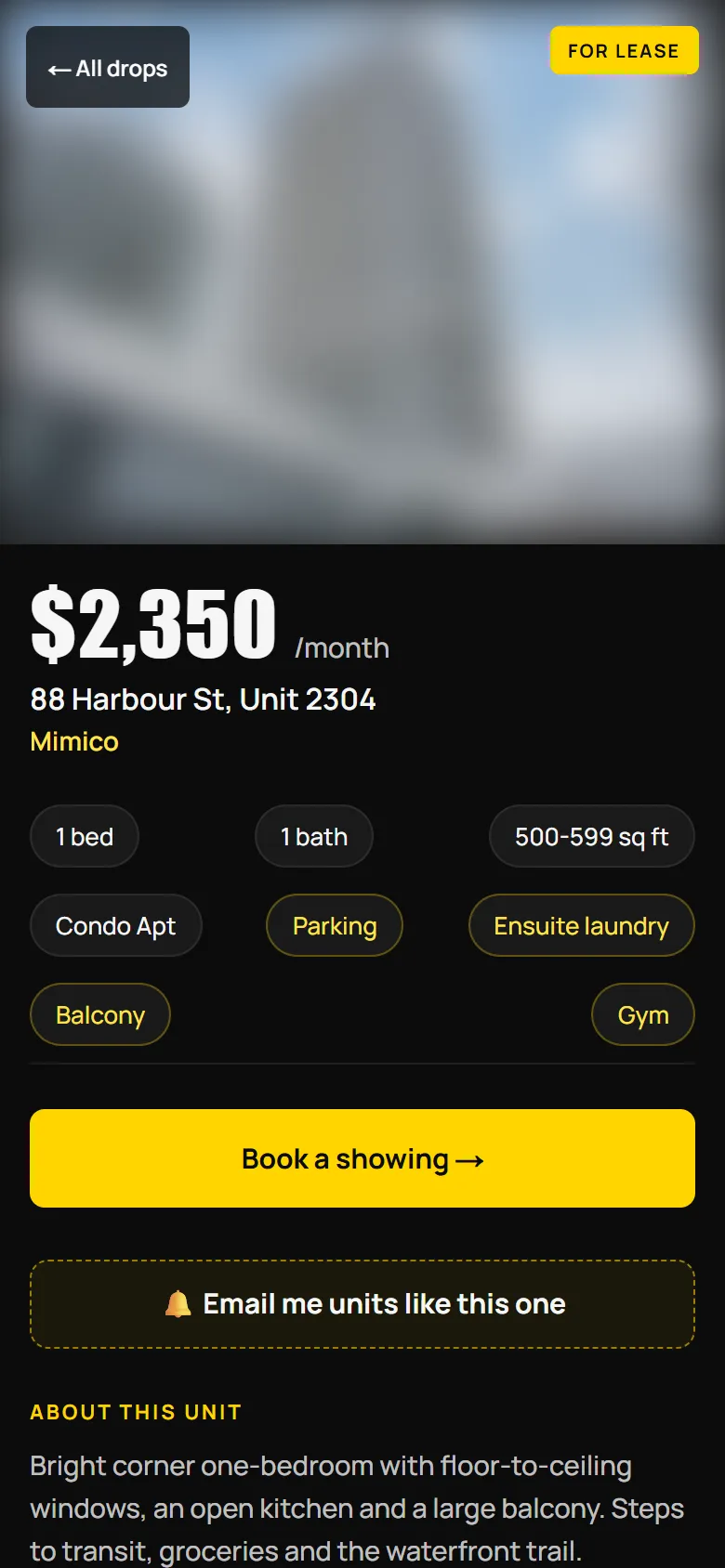
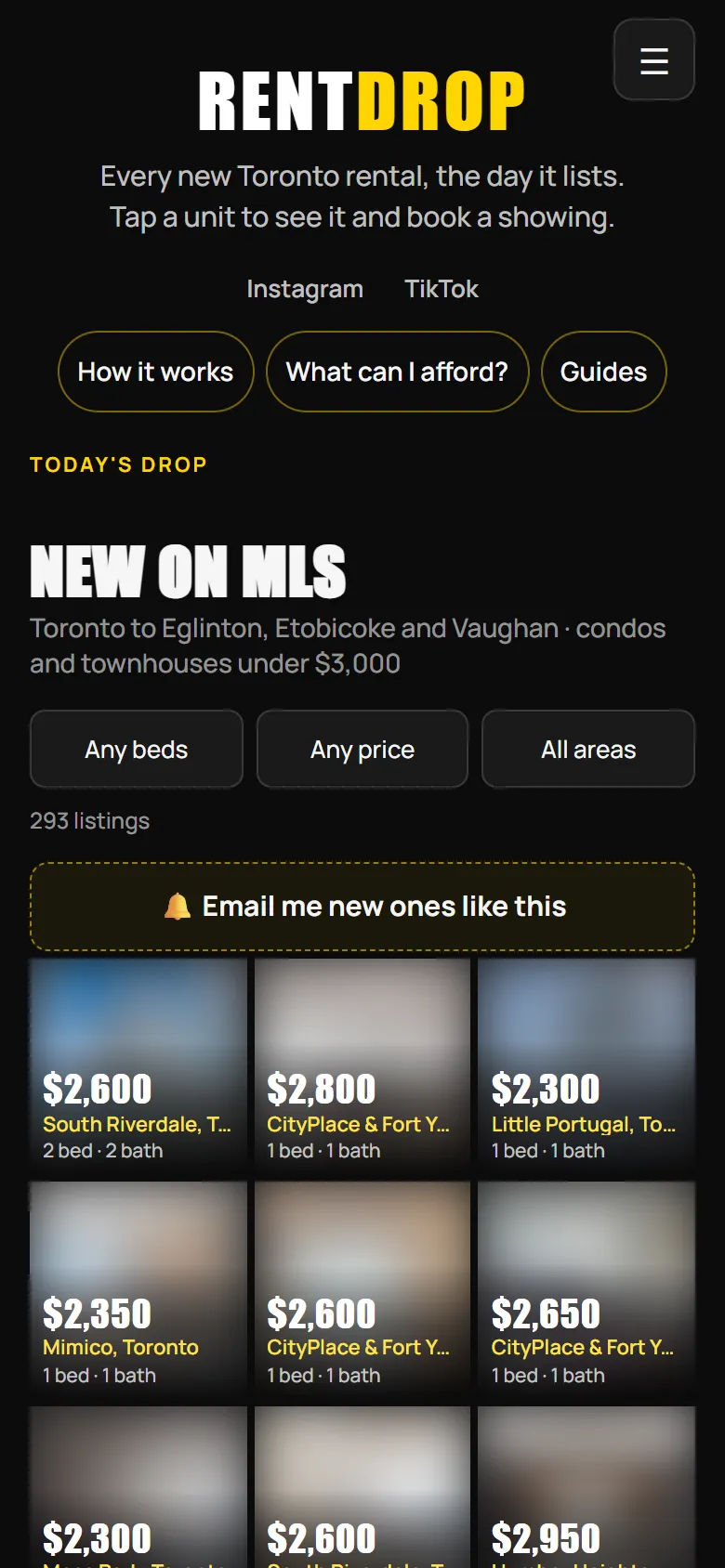
Real RentDrop screens. Listing photos blurred; renter details are sample data.
THE SITUATION
One agent. A hundred manual steps. No sleep schedule.
Rental leads in Toronto don't wait. A landlord picks the first complete application — not the most interested renter, not the one who called. The first one who shows up with the paperwork.
For a rental operation running primarily through Instagram, that created a predictable problem. Leads arrive at all hours. Qualification happens over direct message. Showing requests get fielded one at a time. Documents are chased by email. Renters are left wondering where they stand. One agent covering every step, with no capacity to grow.
The bottleneck wasn't effort. It was process — and every hour it ran manually was an hour a competitor could pick up the lead instead.
WHAT STEADFAST BUILT
A system that handles the whole sequence.
We designed and deployed an agentic AI workflow across the full showing pipeline. Eight components. One flow from listing to confirmed showing — with a human in the loop for anything that matters.
01 / LISTING SYNC
~950 live listings. Updated automatically.
The full rental inventory is pulled from the MLS feed and published to a mobile-optimized listing grid. New listings are picked up automatically. Leased units are removed daily without anyone touching a spreadsheet.
02 / INSTAGRAM PUBLISHING
New listings go to Instagram without a post scheduled manually.
Listings that meet the criteria are formatted and published to Instagram automatically. In the first week of tracking, 31 listings were posted this way.
08 / AREA ALERTS
Renters on a watchlist get an email when a matching unit is listed.
New listings that match a renter's saved area and criteria trigger an automated email. The lead stays warm without anyone manually checking who to contact.
03 / SHOWING REQUESTS
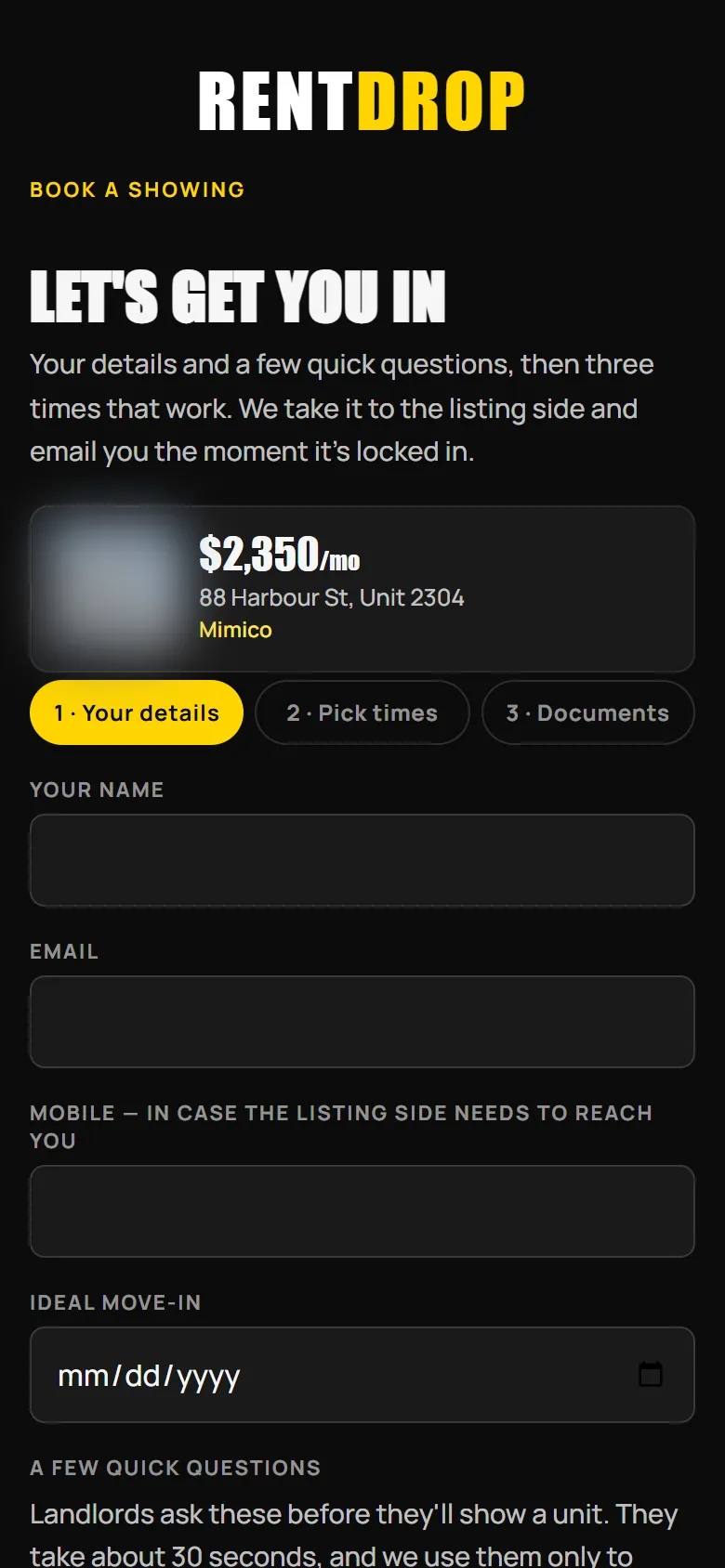
Renters pick three time windows and answer qualification questions — directly from the listing.
No back-and-forth in DMs. No phone tag. The request goes in once, with the information the agent actually needs to make a decision.
04 / INSTANT CONFIRMATION
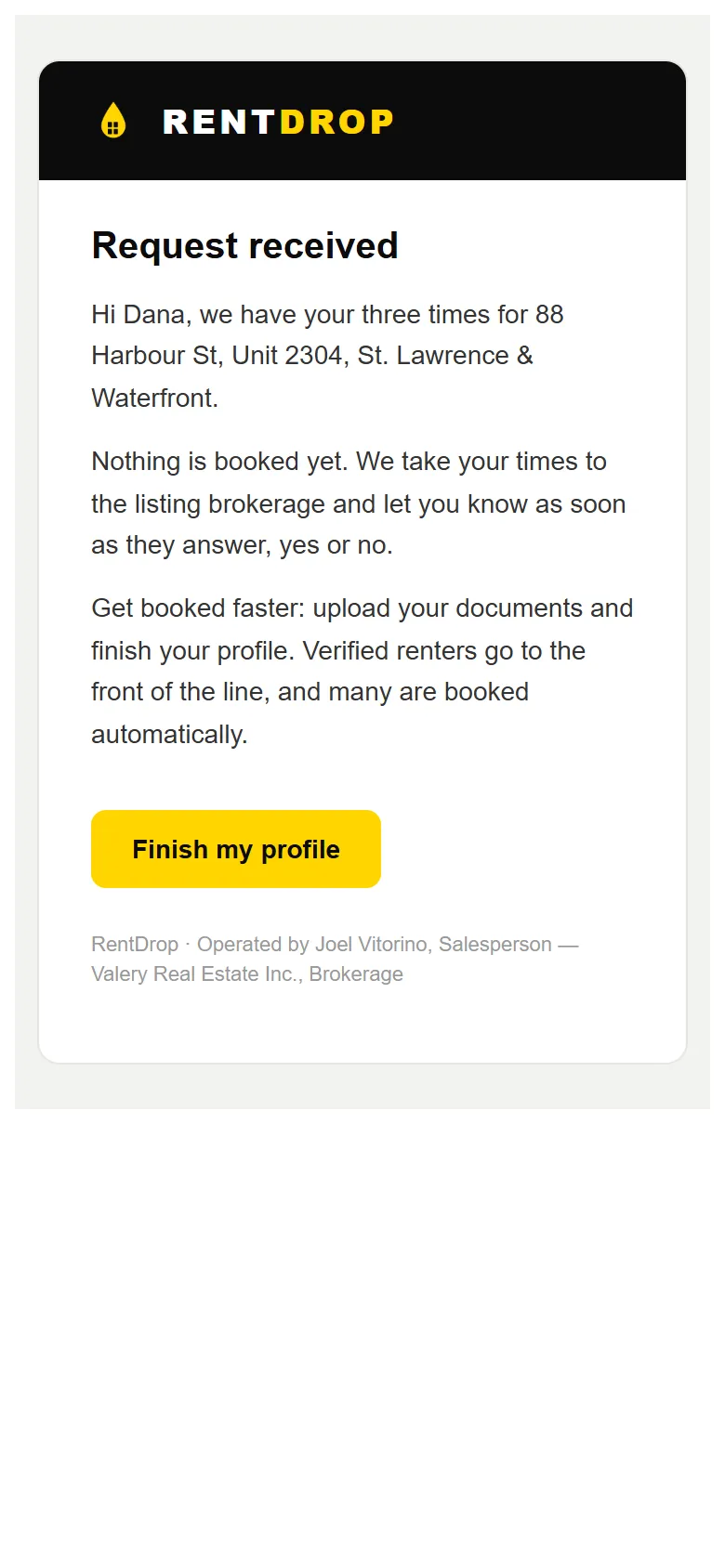
Branded confirmation email within seconds of submission.
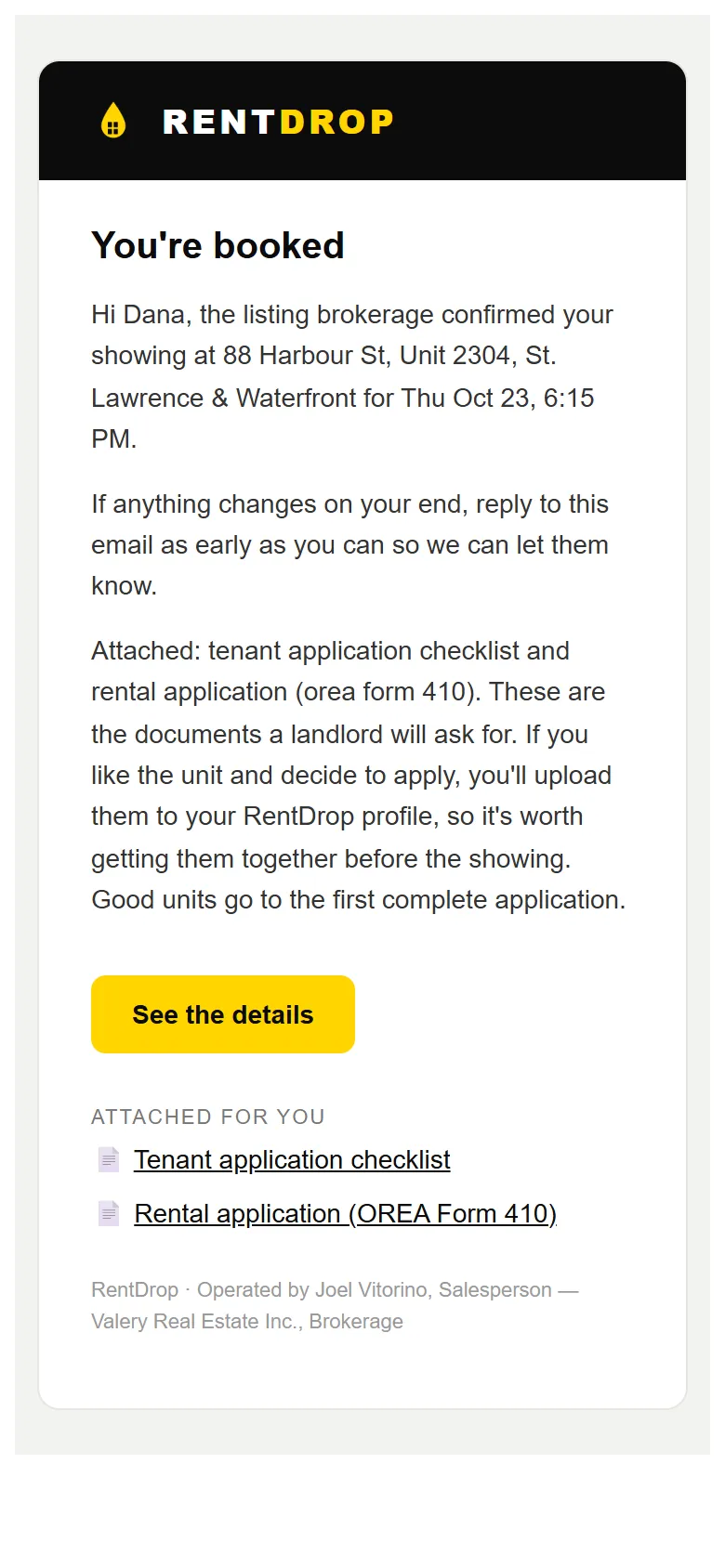
Every showing request triggers an acknowledgement email immediately, with a nudge to start a renter profile. When the showing is confirmed, the application checklist goes with it — so renters know exactly what to prepare. No renter left wondering if the request went through.
05 / AUTOMATED BOOKING
Showing placed on the brokerage booking platform around the agent's real calendar.
The booking system respects the agent's work hours, existing appointments, and travel time. Anything requiring review comes to the desk and triggers a Telegram alert — approve or act directly from the notification.
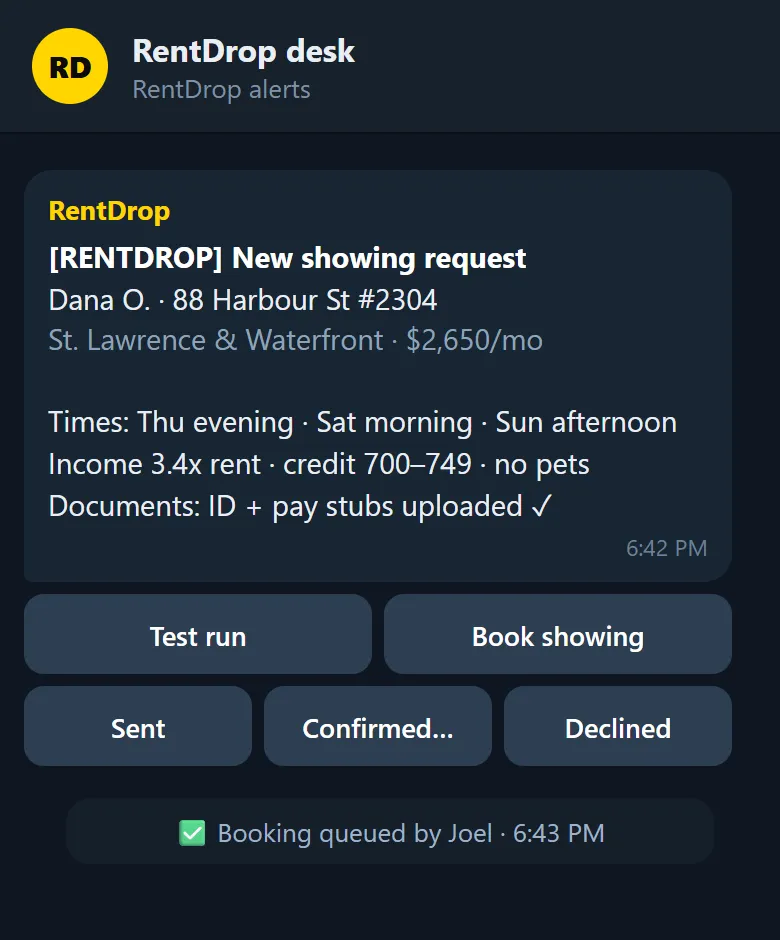
06 / DOCUMENT COLLECTION
Renters upload documents to a personal profile. The system follows up.
Automated reminders go out for missing items. When the showing is confirmed, the application checklist is attached to the booking email — renters arrive knowing what to bring. When rent-to-income is a stretch, an affordability note is included.
07 / TEAM ROUTING
Requests routed to agents by area. Each agent has their own dashboard.
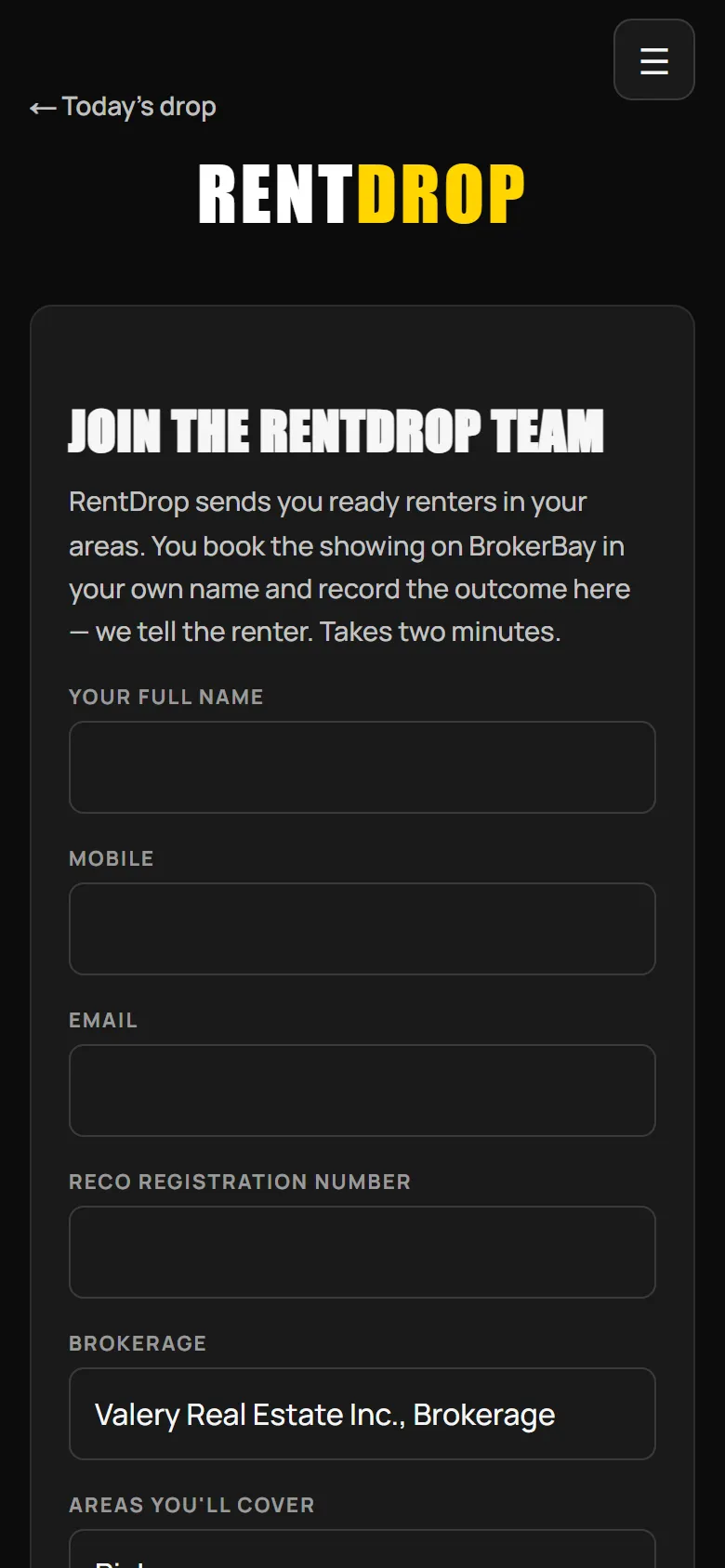
New team agents join through a self-serve sign-up: details, areas, hours and terms, no manual onboarding. A second agent was invited in the first week; downtown requests route to them once approved.
THE RENTER'S JOURNEY
From the grid to the application checklist.
What a renter sees — from browsing a listing to receiving their confirmed booking with the paperwork list attached.
1 · Browse listings
2 · Open a listing
3 · Request a showing
4 · Instant confirmation
5 · Showing confirmed
Real RentDrop screens. Listing photos blurred; renter details are sample data.
EARLY RESULTS, FIRST WEEK OF TRACKING (OCT 15–20, 2026)
The first numbers. Unrounded.
Six days of data. Not enough to draw firm conclusions — enough to know the system is running and where to look next.
VISITOR FUNNEL
OPERATIONS
Confirmation time
Seconds
Every showing request triggered an email confirmation within seconds of submission — without manual action
Live listings synced
~950
Rental listings kept in sync from the MLS feed automatically
New listings picked up
436
New units automatically added to the grid in the tracking week
Leased units removed
119
Leased units removed from the public grid automatically — no manual cleanup required
Auto-posted to Instagram
31
Listings published to Instagram automatically in the tracking week
Agent onboarding
Self-serve
A second agent was invited in the first week through the self-serve sign-up; downtown requests route to them once approved
Tracking started Oct 15, 2026. These numbers reflect a partial first week of data. They will be updated as the system matures.
WHAT WE'RE MEASURING NEXT
The numbers that matter more.
Week-one data shows the system runs. These are the metrics that will tell us whether it works — in the ways that count.
- Request-to-booked time How long from a renter submitting a showing request to a confirmed booking on the calendar. This is where manual steps used to pile up.
- Booked-to-leased rate How many confirmed showings result in an application — and eventually a lease. The number that ties the pipeline to revenue.
- Hours saved per week Manual steps removed from the agent's plate: qualification, confirmation, scheduling, document follow-up. This is the actual time cost of the old process.
- Agent response times How quickly routed requests are actioned by agents on the team dashboard. The system routes; humans still close.
Numbers will be updated here as tracking continues. The ones above are baselines, not benchmarks.
WANT THIS FOR YOUR OPERATION?
Start with the AI Readiness Audit.
We map the workflow, find where the manual drag is costing you leads or hours, and scope a system around what your operation actually needs. No pitch, no one-size package. Just a clear read on where to start.